gridfall
GridFall — a SimCity-style city run by GMI Cloud AI
Watch the trailer · Website · Download v0.1.0 · Write-up on DEV
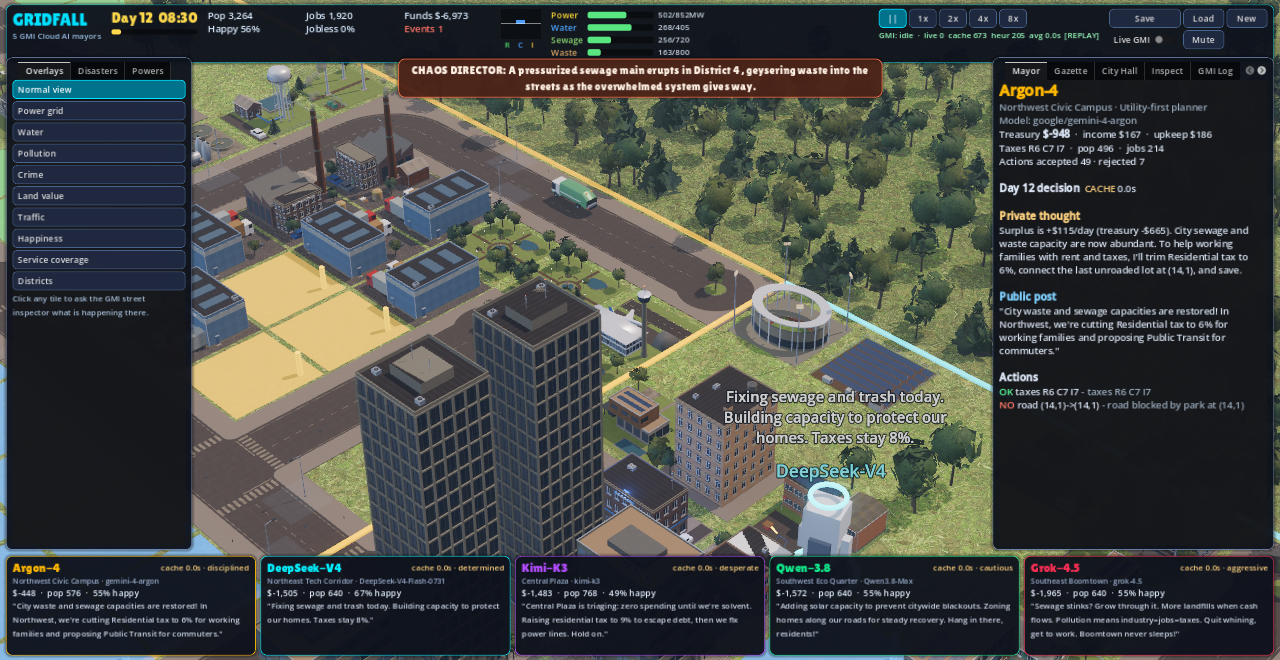
GridFall is a 3D SimCity-style city builder made with Godot 4.7 (Forward+), Blender, GMI Cloud inference and ACE-Step 1.5 audio. You don’t build the city. Five autonomous AI mayors do, each running on a different GMI Cloud model. Every other layer of the city also has a GMI model behind it. You watch, inspect and intervene.
GridFall was built with Factory’s Droid coding agent, which wrote the Godot code, the Blender asset pipeline and the tests. Every mayor, resident and city agent runs on GMI Cloud inference.
The AI city
| Role | Model | What it does |
|---|---|---|
| Mayor Argon-4 (NW Civic Campus) | google/gemini-4-argon |
Utility-first planner |
| Mayor DeepSeek-V4 (NE Tech Corridor) | deepseek-ai/DeepSeek-V4-Flash-0731 |
Systems engineer |
| Mayor Kimi-K3 (Central Plaza) | moonshotai/kimi-k3 |
Coalition builder |
| Mayor Qwen-3.8 (SW Eco Quarter) | Qwen/Qwen3.8-Max |
Fiscal pragmatist |
| Mayor Grok-4.5 (SE Boomtown) | x-ai/grok-4.5 |
Growth maximalist |
| Citizen Voices | MiniMaxAI/MiniMax-M3 |
Residents react to their real tile data |
| GridFall Gazette | XiaomiMiMo/MiMo-V2.6-Flash |
Daily newspaper and editorial |
| Council Speaker | openai/gpt-6-luna |
Rules on ordinances the mayors propose and vote on |
| Chaos Director | deepseek-ai/DeepSeek-V4-Pro |
Picks disasters that test real weaknesses |
| Grid Operator | google/gemini-3.8-flash |
Sets the power load-shedding priority |
| Street Inspector | MiniMaxAI/MiniMax-M3 |
Click any tile; whoever is standing there tells you what’s wrong |
Once per in-game day, each mayor gets an ASCII map of its district, district and city stats, open lots, its open construction sites, land it can annex, yesterday’s results, other mayors’ posts, letters from its residents, the Gazette headline, open proposals and any player decree. It replies with JSON: a private thought, a public post, a mood, up to 7 actions (road, zone, build, bulldoze, taxes, emergency, grant, annex), an ordinance proposal and votes. The simulation checks every action and rejects invalid ones with a reason.
Simulation
- World: the founding city is 32×32 tiles (x,y 0..31) with a river, forests and five districts, inside a 192×192 frontier (x,y -80..111) of unclaimed woods, lakes and the river. Mayors annex unclaimed 16×16 plots that border their district; each plot costs a little more than the last ($1500, then +$400). Surveyors map land up to two plots beyond claimed territory; the frontier past that sits under a haze that lifts as the city grows. Per-tick systems and most view passes only touch claimed land plus a 3-tile margin, trees are drawn in chunks that switch to low-poly stand-ins far from the camera, so the bigger world costs little. Saves from the old 96×96 world load into the same place in the bigger one.
- Zoning: R/C/I demand and density growth (levels 1–3). Growth depends on road access, power, water, land value and taxes.
- Utilities: a power network that flows through roads and buildings, with load shedding; coal, solar and wind power (wind is stronger near water or the map edge); water pumps (stronger near the river); sewage capacity; garbage collection through landfills (a waste shortage adds pollution and lowers happiness).
- Services: police, fire, hospital, school and parks, each with a coverage radius.
- Big projects: stadium (leisure coverage), train station (transit cuts traffic by up to 40%), university (wide school coverage), and airport (jobs plus commercial and industrial demand, but it pollutes). Each mayor has a favorite project once its city passes 900 residents.
- City maps: traffic, pollution, crime, land value and happiness.
- Economy: a budget for each district (taxes, upkeep, ordinance costs), plus 10 citywide ordinances.
- Disasters: 8 types (fire, blackout, sewage burst, gridlock, smog, earthquake, flood, tornado).
- Staged construction: see below.
- Time speeds: pause, 1x, 2x, 4x, 8x. A day waits for the mayors’ GMI calls (up to 75s).
- Save and load to
user://gridfall_save.json(atomic write, previous save kept as.bak). The game autosaves each morning and on quit, and continues the saved city on launch;GRIDFALL_NEW_CITY=1starts fresh.
Residents
About 100 named residents (one per ~10 people) each have a job, skills, traits, a household, a home, savings and a memory. Their GMI minds (scripts/ai/resident_minds.gd, batched) decide each day whether to go to work, how to commute, where to spend, what to do in the evening (including helping neighbours or protesting at city hall) and whether to move away. Traffic, wages, sales tax and moods come from those decisions instead of fixed formulas.
Incidents (fires, broken water mains, downed power lines, crashes, quakes…) never end on a timer: they stay broken until residents with the right skills and paid city crews put in enough repair work. Residents write to their mayor, and the mayor reads those letters the next day. Click a person in the city, or use the People tab, to read their mind.
Staged construction
Nothing appears instantly once people live in the city. Every build order opens a construction site (+ on the AI map) that goes through stages:
| Site | Stages |
|---|---|
| Service buildings | clearing → excavation → foundation → frame → finishing (solar, wind and landfill skip excavation; parks are clearing → landscaping) |
| Zoned lots (private developers) | houses: foundation → frame → finishing; shops/factories: excavation → foundation → frame → finishing; towers rebuild from the foundation; smaller upgrades add a frame and facade around the building while people keep living there |
| Roads / bridges | clearing → grading → paving / piling → decking → paving |
| Demolition (bulldoze) | demolition → hauling (trees: clearing; rubble: hauling) |
The paid contractor puts CREW_RATE work points into every open site each tick (4 ticks a day). With contractors alone a park takes about a day, a road a day, a bridge 2.5 days, a police station 3, a hospital 4, a coal plant 9, a stadium 12 and an airport 15. Private developers take about 2 days for houses and 6 for a tower, and run at most MAX_ZONE_SITES (10) sites per district at once. Residents with construction skills (construction workers, civil engineers, electricians, water engineers) spend their working day on the nearest site; together they can add up to HELPER_CAP (60%) of a contractor shift per tick. They are paid a day rate, remember what they helped build, and show up in the tile inspector’s crew list. A building does nothing until it is finished. Sites survive save/load.
Orders you place on foot from the phone go to your own two building crews instead of the contractors. A crew builds one order at a time in real time: 2 minutes for a park up to 5 for the airport at speed 1, and 10 seconds per road tile. A third order waits for the first crew to free up. You can watch them work on site: a foreman by the gate, two builders, and a hauler carrying crates from a pile to the work. A board over the gate names the crew, the order, the stage and the time left. They stand on the ground, among the rebar, on the slab and between the frame’s columns, and on the scaffold once the building fills its lot. A crew that takes an order while you play walks in through the gate.
Progress shows continuously, not stage by stage: the view runs each site forward between ticks at its recent work rate, and each stage changes as work goes in. Trees come down and stumps are pulled, the pit widens and the spoil heaps grow, rebar goes in before the slab is poured across, the frame rises floor by floor, safety netting rolls up, asphalt is laid end to end, bridge piers rise, and demolished buildings sink into a growing rubble pile that is then hauled away.
The view draws each stage with a fenced dirt lot, an excavated pit with spoil heaps, a wet concrete slab with formwork and rebar, a rising concrete frame (floor by floor), scaffolding with safety netting around the finishing building, and a floodlight. Animated procedural machines work the sites: excavators, JCB-style backhoe loaders, tipping dump trucks, cement mixers with turning drums, tower cranes with slewing jibs and moving trolleys, bulldozers and road rollers.
Founding builds made before anyone lives in the city, and runs with residents off, are still instant. CitySim.construction_mode can force "staged" or "instant".
City life
- Zone lots pick from a library of houses, apartments, shops, offices, skyscrapers, warehouses and plants for each density level (
models/zones/<r|c|i><level>/). Built lots get trees, benches, lamps, hydrants, planters, bins and billboards. - Bus stops appear on straight roads next to homes and shops. Buses stop there and also run out of train stations.
- Delivery trucks run from industry, and garbage trucks from landfills.
- Every disaster sends a crew: fire trucks, ambulances and police drive the road network from the nearest station to the event with sirens flashing, stay until it ends, then leave.
- Boats sail the river’s open water: they float at the surface and turn back at a bridge instead of sailing through it. Airports run a plane that takes off, circles the city and lands again; hospitals get a circling helicopter when the model is present.
- Wind farm rotors spin and rooftop beacons blink.
- On foot, some people walk a Shiba Inu or a husky on a lead, and homes with a dog keep it in the front yard. By day flocks of pigeons peck about on the sidewalks in front of shops and civic buildings and in the parks. Cats keep to some front yards and shop doors, and by night strays prowl the works yards and the parks. Kick one or hit it with a bat and it reacts: a dog yelps and runs off (a barky one goes for you), a cat yowls and bolts, a pigeon goes up in a puff of feathers with its flock.
Rendering
- Realistic models in
models/real/(zones, service buildings, roads, props, vehicles, people) are used whenever they exist, with the Kenney and earlier Blender models as fallbacks. - HDRI sky that blends day, dusk and a procedural starry night; a 24-hour day/night cycle (
scripts/world/sky_director.gd) drives the sun, fog, exposure, lit windows and street lamps with pools of light. - PBR grass, dirt, asphalt and sidewalk (Poly Haven CC0), a water shader with moving normals and fresnel, ACES tonemapping, SSAO, SSIL, glow and aerial-perspective fog.
- Model materials are tuned at load: roofs, brick, concrete, plaster, stone, wood and paving are matte (the source textures marked them fully metallic, which made roofs mirror the sky), sheet metal is semi-matte, and glass and chrome keep a soft sheen.
Player controls
godot --path . starts in first person at street level. Set GRIDFALL_VIEW=orbit to play the orbit city builder with the full HUD described below.
- First person: WASD or the arrow keys walk, Shift runs, Space jumps (in front of a railing, a bench or a low wall your character vaults over it instead, and in front of a ledge up to about 2 m hops or climbs up onto it; at a taller wall they leap onto it and hold on, hands and feet on the wall: W and S climb up and down, A and D move along it, Shift climbs faster, at the top they climb over where there is room to stand, Ctrl lets go and Space pushes off it; drop from a height on the move and they roll out of the landing, which hurts far less and keeps them on their feet), mouse to look (click to capture the pointer),
]and[change time speed (1x, 2x, 4x, 8x),Tskips to the next morning,Escpauses,F1hides the HUD,F5saves,F9loads.Fby a car gets in: your character walks round to the driver’s door, opens it, climbs in and shuts it (Fon the way turns back). By a car stopped in traffic with someone at the wheel,Fpulls the driver out: your character opens the door, drags them out and shoves them aside, then climbs in, while they go down, get up, shout at you and run off (a resident walks on to wherever they were going). They and anyone who saw it remember it, and the police are called. W/S throttle and brake or reverse, A/D steer, Space handbrake, V switches chase and driver view, andFagain, once the car slows down, brakes to a stop and climbs out the same way. The car is solid: it bounces off walls, scrapes along them at a glance, shoves the cars it hits (they slide off, then pull back into their lane) and sends bins, benches, planters and other light street props flying. On foot you knock props about too: run into a bin or a wheelie bin, or just walk into a traffic cone or a carton, and it goes over; a punch with nobody in front of you lands on the prop there; and you, people walking and cars kick fallen props along, while one skidding fast knocks over the next. Cones stand in threes in front of construction sites, wheelie bins outside some homes and cartons by some shop doors. People it runs into stagger back, or go down when it is going fast. On foot, left click throws a jab, a cross and a heavier hook in turn at whoever stands in front of you (your character turns to face them),Rshoves them andX(or the middle mouse button) kicks them, from a little further off than a fist reaches; the hook and the kick knock people down. Baseball bats, steel pipes and bottles lie about the city (bats in the parks and by some homes, pipes by the works yards, bottles by the shops):Epicks one up, left click swings it, further and harder than a fist (a pipe or a bottle floors people at once, and a bottle smashes on the first blow), andZdrops it. A blow that lands freezes the moment for a split second and shakes the camera, and someone knocked down is thrown off their feet and bounces before they lie there. Hold right click to put your guard up: fists up and the camera in closer. A light blow makes people reel and step back. A hard one, the third punch in a row or a fast car knocks them down: they lie a while, get up, then shout at you, run off or walk back, and the people nearby who saw it run off or shout too. A resident who was hit remembers it and their mood drops (a shove least, a car most), and the ones who saw it remember it too. Floor someone or keep punching and the police drive out from the nearest station; someone a car knocks down gets an ambulance. The one who was hit and a witness say so in the chat, a crew called to the scene posts a City Alert card, and you hear each blow, swing and fall. Some of the people you punch or shove fight back: they square up, close in and throw jabs and crosses until you go down, get away or drive off, and your guard takes most of a punch from ahead. Your health is the arc round the left of the minimap, with a red edge on the screen when it runs low. Crashes, hard landings, punches, dog bites and cars that cannot stop for you in time (they run you down instead of stopping dead) cost health, which comes back a few seconds after the last hurt. A car or a bad fall knocks you down for a moment, and with no health left you black out and come round outside the nearest hospital, healed.1-5wave, nod, shake your head, shout and dance, and the people around answer. Dogs react to you: a friendly one comes over when you crouch, andEby a dog pets it; a barky one barks at you and at people going by, a shy one keeps its distance, and they all flinch at blows and shouts and leap clear of cars. Punch or shove a dog’s owner and the dog goes for your legs: its bites cost health, and it will not let you pet it for a while. Pigeons walk out of your way and flutter off when you step up to them; sprint at a flock, swing, shout, or let a dog or a car near it and the whole flock goes up with a clatter of wings, wheels round and lands again once it is calm.Ewith the view on the ground by a flock throws it crumbs, and the birds come running. Cats sit, loaf, groom and stroll about: a friendly one comes over to you when you crouch, andEby a cat pets it (it purrs, walks off if it is aloof, or hisses and runs if it is skittish). They bolt from a sprint, a blow, a shout or a car, arch their backs and hiss at dogs, and a hunter stalks the pigeons and pounces. Your fists go over the animals, but a kick or a weapon swing lands on the dog, cat or pigeon in front of you when nobody else is in reach: a dog yelps, is knocked back and runs off whining and wary of you (a barky dog hit lightly goes for your legs instead), a cat yowls, is knocked back and bolts and stays skittish of you, and a pigeon is knocked up in a puff of feathers as its flock takes off.Bopens the build phone:1-6pick road, homes, shops, industry, a building (mouse wheel picks which) or bulldoze, left click places on the tile ahead (roads and zones take a start and an end click), right click undoes the start. Each order is paid by the district that owns the land, as if its mayor had ordered it, and one of your two building crews builds it in real time (see Staged construction). The phone says how many crews are free and how long the order takes, a card under the top bar counts down your orders, andEon a worker gets a word about the job. The AI activity feed (top right) shows each mayor turn, council ruling, Chaos Director pick, grid order and Gazette front page as it lands. A card shows who decided, the model they run on, whether the answer came live, from a replay, from a fallback or from the offline planner, what they did and why. On foot the mayors take their turns spread over the day. A decision with a place raises a light beacon there.Jcycles the feed between full, brief and hidden, andGroutes the GPS to the newest decision with a place. Each of those decisions is also a lead for the Gazette, and you are its stringer:Ktakes the newest on assignment, and a card shows what happened, where and how far, and what the story still needs, while the GPS leads you to the scene. There, a reply from someone you talk to (or the answer when you ask someone here) is your quote. In photo mode (P), a click with the scene inside the viewfinder’s marks is a press photo.Kthen files the story: the Gazette runs it in the chat, the person quoted remembers it, and it earns points towards the press ranks, with bonuses for a scoop (filed within a third of a day), a local voice and a sharp photo. A lead goes cold after a day.Lopens the mayors’ league: the five mayors ranked on people, jobs, approval and funds, each with the model they run on, your press card, the open leads (chase any of them) and your latest stories.
The orbit view (GRIDFALL_VIEW=orbit):
- Top bar: day, population, jobs, funds, happiness, the RCI demand meter, power/water/sewage load, GMI call status, speed, Save/Load/New, Live GMI toggle, Mute.
- Overlays tab: 3D data views for power, water, pollution, crime, land value, traffic, happiness, services and districts.
- Disasters tab: arm a disaster, then click the map. There is also a random target option and “Restore all”.
- Powers tab: send a decree to all mayors, grant funds, and override ordinances.
- Mayor cards (bottom): click a card to focus that district and read its latest thought, post and action results.
- Right panel: Mayor, Gazette, City Hall (council, operator, chaos, citizens), Inspect, GMI Log, Feed.
- Keys: WASD pan, mouse wheel zoom, right-drag rotate,
Crecenter,Spacepause,1–4speed,Esccancel an armed disaster,F5save,F9load.
GMI inference and fallbacks
scripts/ai/gmi_client.gd calls https://api.gmi-serving.com/v1/chat/completions. The API key comes from GMI_API_KEY or from the GMI entry in ~/.factory/settings.json. Hybrid reasoning models get per-model settings so they answer instead of spending the whole token budget on reasoning: DeepSeek and Kimi get thinking: disabled, Qwen gets enable_thinking: false, and Grok gets reasoning_effort: low. A model that refuses the default temperature of 0.7 with an HTTP 400 (Kimi-K3 takes only 1) is tried again at once with 1 and keeps it for the session. Every failed live call prints one GMI_FAIL <role>/<agent> on <model>: <error> line to the output (scrubbed; never the prompt), so a run from the editor shows why replies fell back.
Each call falls back in this order:
- Live GMI response.
- Replay cache: real recorded responses in
data/gmi_replay_cache.json(22 days are included), nearest day for the same agent. - Heuristic fallback for that role.
The source of every call (live, cache or heuristic) is shown on the mayor cards and in the GMI Log.
The replay cache was recorded before wind farms, landfills and the big projects existed. On a replayed day, a mayor therefore also borrows at most one of those builds from its heuristic planner, and only when the district can still afford it after the replayed actions.
GRIDFALL_OFFLINE=1   # never call GMI (replay cache + heuristics)
GRIDFALL_RECORD=1    # write live responses into data/gmi_replay_cache.json
GRIDFALL_SPEED=4     # starting game speed
GRIDFALL_RESIDENTS=0 # no AI residents (old formula behaviour, instant construction)
LIVE_RESIDENTS=30    # residents_live test: how many residents call GMI (default 30)
GRIDFALL_HOUR=21.5   # freeze the clock at this hour (e.g. for night screenshots)
GRIDFALL_VIEW=orbit  # play the legacy orbit view with the full CityHud (default: first person)
GRIDFALL_MOUSE=free  # first person: never capture the mouse pointer
GRIDFALL_FP_SMOKE=1  # headless first-person smoke test (see Running)
GRIDFALL_FP_PHOTO_DIR=/tmp/gf_fp  # first-person photo tour: save eye-level shots to this folder
Running
# Play (first person; add GRIDFALL_VIEW=orbit for the orbit view and CityHud)
godot --path .
GRIDFALL_VIEW=orbit godot --path .

# The gate: parse check and unit tests (quick), plus the orbit and first-person smokes (full),
# or the windowed first-person photo tour and perf report (render). Runs offline in temp user dirs.
tools/gate.sh quick
tools/gate.sh full
tools/gate.sh render

# First-person headless smoke and photo tour
GRIDFALL_FP_SMOKE=1 godot --headless --path .
GRIDFALL_FP_PHOTO_DIR=/tmp/gf_fp GRIDFALL_PHOTO_DAYS=6 godot --path . --resolution 1600x900

# Headless smoke test (offline: 6 days, quake + crews, overlays, inspector, save/load round trip)
GRIDFALL_SMOKE_TEST=1 godot --headless --path .

# Photo tour: grow the city offline, then save landmark, dusk, night, construction and fire shots
# (GRIDFALL_PHOTO_SHOWCASE=1 also builds any missing big project first)
GRIDFALL_PHOTO_DIR=/tmp/gf_photos GRIDFALL_PHOTO_DAYS=12 godot --path . --resolution 1600x900

# Trailer: a ~30 s 1080p clip with captions and a ticker of live GMI mayor calls
# (grows a city offline once, then records with Movie Maker and encodes an MP4 for X)
tools/record_trailer.sh trailer/gridfall_trailer.mp4
# Sim unit test and a live two-day brain test
godot --headless --path . -s tools/tests/sim_test.gd
godot --headless --path . -s tools/tests/buildings_test.gd
godot --headless --path . -s tools/tests/residents_test.gd      # residents, incidents, save/load
godot --headless --path . -s tools/tests/expansion_test.gd      # annexation, survey, old-save migration, 192x192 world
godot --headless --path . -s tools/tests/construction_test.gd   # staged construction and crews
godot --headless --path . -s tools/tests/brain_live_test.gd
LIVE_RESIDENTS=10 godot --headless --path . -s tools/tests/residents_live.gd

# Rebuild the realistic models (procedural Blender + Poly Haven CC0 textures) and validate them
blender --background --python /abs/path/to/tools/blender/make_realistic_city.py -- all
blender --background --python /abs/path/to/tools/blender/validate_real.py

# Rebuild the Blender GLB assets (includes coal plant, water tower, police, fire, hospital, school, apartment tower, factory)
blender --background --python /abs/path/to/tools/blender/make_gridfall_assets.py -- all

# Re-import the Kenney CC0 kits into models/zones, models/props and models/vehicles
blender --background --python /abs/path/to/tools/blender/import_kits.py
Development setup
tools/setup.sh                       # venv with pinned tools, pre-commit hooks, first asset import
pre-commit run --all-files           # gdlint, gdformat --check, large files, secret scan
python tools/checks/run_all.py       # complexity, dead code, duplicates, module boundaries, TODOs, flags
python -m pytest                     # Python tooling tests (coverage gate, >= 80%)
Requires Godot 4.7.x (.godot-version) and Python 3.10+. Run the Python tools from the venv tools/setup.sh creates (. ~/.venvs/gridfall-tools/bin/activate). A dev container with both is in .devcontainer/. See AGENTS.md and CONTRIBUTING.md for rules and workflow, and docs/runbooks/ when something breaks.
Build and export
tools/export.sh linux                # build/linux/gridfall.x86_64 (+ .pck)
tools/export.sh windows              # build/windows/gridfall.exe (+ .pck)
tools/export.sh all                  # both presets in export_presets.cfg
Export needs the Godot export templates for the version in .godot-version (Editor > Manage Export Templates, or tools/export.sh prints the download commands when they are missing). Releases are cut with tools/release.sh <version> (for example tools/release.sh 0.2.0), which updates VERSION and CHANGELOG.md, commits and tags; pushing the tag runs the release workflow, which runs the gate, exports both platforms and publishes a GitHub Release with zips, checksums and generated notes. Each zip also carries the player guide tools/release/PLAYING.md (which heads the release notes) and a play-orbit launcher for the orbit view.
Code map
scripts/sim/sim_defs.gd: rules, costs, ordinances, disasters, mayors, support agents.scripts/sim/city_sim.gd: tile simulation, actions, annexation, construction sites, disasters and incidents, summaries for the AI, save/load.scripts/sim/residents.gd: the resident population, their days, jobs, money, incident help and construction crews.scripts/ai/resident_minds.gd: batched GMI minds for residents.scripts/ai/gmi_client.gd: GMI HTTP client, JSON extraction, replay cache, call log.scripts/ai/city_brain.gd: prompts and the daily schedule for all GMI agents.scripts/world/city_view.gd: 3D renderer (roads chosen by neighbor mask, buildings by density, services, props, bus stops, cars, pedestrians, effects, overlays, click to inspect).scripts/world/city_life.gd: buses, trucks, emergency crews, boats and aircraft.scripts/world/construction_kit.gd: construction site stages and the animated machines.scripts/world/resident_avatars.gd: residents as walking and driving people you can click.scripts/world/sky_director.gd: day/night cycle and sky.scripts/ui/city_hud.gd: HUD.scripts/main.gd: wiring, save/load, smoke test.scripts/cinematic.gd: the scripted trailer (camera path, captions, live GMI ticker).
License
GridFall’s code is released under the MIT License. Third-party assets keep their own licenses, listed below.
Asset credits
Building, prop and vehicle models in models/zones, models/props and models/vehicles are adapted from Kenney asset kits (CC0). See models/LICENSES/. The realistic set in models/real/ is procedural Blender geometry with Poly Haven CC0 textures, HDRIs and a few embedded Poly Haven models; see models/real/LICENSES/polyhaven.txt. The dogs in models/real/animals/ are Quaternius’ Shiba Inu and Husky (CC0); see models/real/LICENSES/quaternius-dogs.txt. The cat there is Quaternius’ Cat (CC0); see models/real/LICENSES/quaternius-cat.txt.
Assets from earlier GridFall versions
concepts/*.png:hy-image-v3.5-previewconcept sheets made withtools/gmi/generate_concepts.py.sounds/music/*.wav: ACE-Step 1.5 stems (96 BPM nominal, 122 BPM crisis).audio_director.gdcrossfades between them based on blackouts and active disasters.- The original 8-tick crisis episode player (
episode_player.gd,gridfall_world.gd,gridfall_hud.gd,tools/gmi/run_episode.py) is still in the repo but is no longer used by the main scene.